Conversion rate optimization (CRO) increases the percentage of visitors who complete a desired action—such as purchasing, subscribing, or registering—by systematically improving websites, apps, or marketing assets. CRO combines user research, analytics, A/B testing, and personalization to remove friction and guide decisions.
Benchmarks vary by industry. Most websites convert between 2–4% overall, with e-commerce closer to 2.5–3% (IRP Commerce, 2024; Statista, 2024). Performance marketing landing pages in high-intent sectors can reach 7–10% (WordStream, 2023). Reported ROI from CRO initiatives ranges widely, but systematic optimization often produces 10–30% uplifts in revenue (McKinsey & Company, 2023) and can achieve payback within 6–12 months when guided by disciplined experimentation (Forrester Consulting, 2023; HBR Kohavi et al., 2017).
Why do visitors drop off? What motivates them to act? CRO focuses on these questions. Businesses can convert existing traffic into paying customers without needing more advertising. This article explains CRO in simple terms. It shows why it matters. It gives you a step-by-step roadmap for optimizing your own website. These conversion rate optimization strategies help increase conversions. They enhance user experience. They guide potential customers smoothly through the conversion funnel.
Analytics track user behavior to identify friction points in the conversion process. This helps businesses find exactly where website visitors hesitate or leave the funnel. CRO improves user experience by removing barriers to conversion. It makes each web page more intuitive for the target audience.
This is a data-driven approach. It relies on measurable insights, not guesswork, to improve the website’s conversion rate. All changes are user-focused enhancements. They ensure the conversion rate optimization process benefits both potential customers and existing users. CRO involves continuous testing and iterative improvements. These are small, repeatable changes that add up over time.
Every design choice follows goal-oriented design principles. Each key element supports a specific conversion objective. Personalized user experiences adapt content, product features, and CTAs to match user segmentation and intent. Strategic funnel optimization improves each stage of the user journey. Results are measured through performance tracking to ensure ongoing success.
The conversion challenge – why websites underperform
The mobile conversion gap
The mobile conversion challenge represents one of the most pressing issues facing digital businesses today. While mobile devices now generate roughly 75% of retail sessions according to Dynamic Yield’s 2025 benchmark, they consistently underperform desktop in actual conversions, achieving only 2.8% compared to desktop’s 3.2%. This gap becomes even more concerning when considered alongside PwC’s finding that 32% of customers will abandon a brand after just one poor experience, and that mobile users are five times more likely to abandon tasks on non-optimized sites.
The cart abandonment crisis illustrates just how costly these mobile friction points can be. Baymard Institute’s analysis reveals that while desktop cart abandonment hovers around 70%, mobile abandonment frequently exceeds 80%. The culprits are predictable yet persistent: small screens that force pinch-zooming, slower connections that test patience, and complicated forms that feel impossible to navigate with thumbs.
Understanding where users struggle requires looking beyond basic conversion rates to examine the entire user journey. Research from the University of Wisconsin emphasizes that businesses must track metrics like bounce rate and engagement patterns to identify specific drop-off points. When teams discover where mobile users hesitate or leave, they can redesign those critical moments – whether that means reducing form fields by 10%, adding payment options, or eliminating the need to re-enter data.
Industry averages & why they matter
Understanding industry benchmarks provides crucial context for evaluating your site’s performance and setting realistic improvement targets. Studies from Ruler Analytics show that average conversion rates across industries hover around 3.3%, with e-commerce sites typically achieving between 2.5% and 3%. These figures serve as a baseline for assessing performance before optimization efforts begin.
However, more recent data reveals higher performance standards. Based on Unbounce’s 2024 analysis of over 41,000 landing pages and 57 million conversions, the median conversion rate across all industries is 6.6%, with industry-specific rates ranging from 3.8% to 12.3% (source: The Unbounce Conversion Benchmark Report 2024). These numbers show that conversion potential varies widely and even small improvements can move a site into the top tier.
Low conversions often reflect underlying user experience problems. Recent research consistently shows that about 88% of online shoppers are less likely to return to a website after a bad user experience, underscoring the critical impact of UX on customer retention and sales.
Additionally, only 22% of businesses express satisfaction with their current conversion rates, according to HubSpot data, highlighting widespread challenges in achieving optimal performance. Together, these statistics signal a significant opportunity for businesses to improve conversions through focused optimization efforts.
High bounce rates, slow load times, and confusing calls-to-action (CTAs) all contribute to underperformance. Recognizing these specific gaps represents the first step toward systematically closing them and unlocking your site’s conversion potential.
Benefits of CRO – why optimization is essential
ROI & revenue gains
CRO is more than a nice-to-have. It delivers measurable, high-converting financial benefits.
CRO is more than a nice-to-have. It delivers measurable, high-converting financial benefits. Well-structured CRO programs consistently generate measurable returns. Independent research finds that systematic experimentation typically drives 10–30% revenue uplifts (McKinsey & Company, 2023) and can deliver payback within 6–12 months (Forrester Consulting, 2023; Kohavi et al., 2017).
These returns come from turning existing traffic into revenue. This improvement doesn’t require additional advertising spend. Such results show how strategic, data-driven adjustments can meaningfully increase sales and leads.
A/B tests compare page variants to find the highest-converting design. This ensures that even small design choices are supported by measurable results. Personalized CTAs increase leads and sales. They match offers to the visitor’s intent and stage in the user journey.
Websites guide visitors to take action through optimized funnels. These simplify decision-making and reduce drop-off. Campaigns are optimized based on real-time performance data. This data comes from website analytics, user interactions, and behavioral data.
Personalization & AI impact
Personalization powered by artificial intelligence delivers experiences that are more relevant, engaging, and profitable. AI-driven tools analyze large datasets to predict what each visitor is most likely to engage with—whether it’s product recommendations, targeted content, or personalized calls-to-action.
The business case is clear: personalized CTAs convert dramatically better than generic ones, and Gartner predicts AI use in testing and personalization will grow from just 5% of companies in 2021 to 30% by 2025. Early adopters gain a competitive edge by reducing decision fatigue, strengthening customer loyalty, and optimizing resource allocation.
The Northwestern University Medill program emphasizes that personalization can amplify relevance, enhance engagement, and lower friction in the buying journey. Even modest implementations—like segmenting offers for first-time versus returning visitors—can yield measurable conversion lifts. Over time, scaling to advanced capabilities such as dynamic pricing and predictive lead scoring compounds these benefits, turning personalization into a high-ROI driver of CRO success.
Measuring and benchmarking your conversion rate
Calculating conversion rate
Mathematically, conversion rate is the number of completed desired actions divided by the number of visits, expressed as a percentage.
For example, let’s say 1,000 visitors arrive on a landing page. If 50 sign up for a newsletter, the conversion rate is 5%. Desired actions can range from purchases to lead form submissions. They can include downloads and trial requests. Each goal requires its own calculation to gauge performance.
When working with multiple channels, track conversions separately. Do this for paid ads, organic traffic and email campaigns. This reveals which channels deliver the most engaged users.
Tools like Google Analytics, Mixpanel and built-in dashboards help calculate these rates. E-commerce platforms have these dashboards too. Remember to account for micro-conversions. These are smaller steps like adding an item to a cart or starting checkout. They indicate user intent. They can inform broader optimization efforts.
Benchmarks across industries
While each business is unique, industry benchmarks provide essential context for measuring performance. Unbounce’s 2024 data (median 6.6%) reinforces the gap between median performers and top-tier conversion leaders.
Earlier Ruler Analytics findings—averaging around 3.3% overall and 2.5–3% for e-commerce—highlight how benchmarks have evolved and underscore the importance of comparing your site’s performance to current, sector-specific norms. Top performers in these categories often achieve double-digit conversion rates, demonstrating the significant growth potential available through effective CRO strategies.
Comparisons should also distinguish between devices and channels as mobile conversion challenges remain evident. A Baymard Institute UX statistics report confirms that mobile users are 5 times more likely to abandon tasks if a site isn’t optimized for their device, making mobile-first design non-negotiable for sustained performance.
B2B websites often have lower overall conversion rates but generate more valuable conversions per visitor. SaaS products may gauge success through free-trial activations rather than immediate revenue, while service businesses might prioritize consultation requests. Use benchmarks as your starting point, then set goals tailored to your specific business model and conversion objectives.
Key metrics to watch
Beyond the headline conversion rate, several supporting metrics shed light on performance. Use these indicators to diagnose where users struggle. See how they engage:
- Bounce rate – the percentage of visitors who leave after a single page. High bounce rates can signal misaligned messaging. They might indicate poor call-to-action visibility or slow page speed.
- Click-through rate – the proportion of users who click a CTA or link. It gauges how persuasive your offers are. It shows how well you target user intent.
- Session duration & pages per session – measures of engagement. They reveal whether users explore your content or exit quickly. Longer sessions indicate compelling, responsive experiences.
- Cart abandonment rate – the proportion of shoppers who add items to a cart but don’t complete checkout. High abandonment points to friction in payment flows. It might show a lack of trust.
- Drop-off analysis – tracking where users exit a multi-step funnel. This pinpoints specific problem areas. These might be form fields, exit intent on modals or shipping information.
- Form completion rate – the percentage of users who complete a form once they start. Low completion often indicates that forms are too long. They might ask for irrelevant information.
Experts from Iowa State University’s web team explain something important. The conversion rate shows how many visitors say “yes” compared to the total page views. They emphasise removing friction. They recommend keeping forms short. Why? Because many visitors browse on phones and have limited attention spans.
CRO metrics align closely with this view. They assess whether your website helps users achieve their goals (and yours) efficiently. Use qualitative feedback alongside quantitative data. This includes survey responses and customer support logs. It gives you a holistic view of user experience.
Core components of CRO – research, testing and personalization

User research & analytics
Effective CRO begins with understanding your audience. User research methods reveal pain points and motivations. These include surveys, interviews, usability tests and feedback widgets. Heatmaps and session recordings show where users click, scroll and hesitate.
The University of Wisconsin blog explains that examining user flow can identify drop-off points. It finds opportunities for improvement. For example, a retailer might discover that users abandon carts when shipping costs appear.
Quantitative analytics complements qualitative insights. Platforms like Google Analytics, Mixpanel and Adobe Analytics provide data. They show traffic sources, funnels and retention. They allow marketers to segment users by device, channel or behaviour. This uncovers patterns that can guide tests.
Adoption statistics from DemandSage show that the highest adoption rate of CRO tools and techniques is around 69%. Yet 64% of marketers utilize UX testing and 61% use personalization demandsage.com. Those that integrate analytics and UX testing gain a clearer picture. They see what drives conversions.
Comprehensive analytics turn raw numbers into actionable insights. Teams measure click-through rates on call-to-action buttons. They track session duration. They evaluate engagement by traffic source. This helps them understand how different campaigns perform.
By comparing variants in an A/B test, teams can adjust designs. They refine copy. They personalize experiences based on evidence. Strategic segmentation uncovers hidden patterns. You separate new versus returning visitors. You compare mobile versus desktop sessions. This informs where to focus your optimization efforts.
CRO is ultimately a cycle. You understand behaviour. You design hypotheses. You implement changes. You measure the impact on key metrics.
Experimentation: A/B & multivariate testing
Testing is the engine of CRO. In A/B testing, two versions of a page differ by a single element. This might be button color or headline. Performance is compared. Multivariate testing evaluates multiple elements simultaneously.
These experiments reveal what resonates with users. They should be guided by hypotheses rooted in research. For example: “adding testimonials near the CTA will increase sign-ups.”
According to Big Sur’s 2025 CRO statistics, 46.9% of marketers run one or two tests a month. Only 9.5% run 20 or more tests bigsur.ai. This cadence may seem modest. But consistent testing yields compounding gains.
Businesses that test more frequently refine their sites faster. They rigorously analyze results. Tools like Optimizely, VWO and Google Optimize (now part of Google Analytics 4) streamline test setup. They handle statistical analysis.
When running experiments, ensure adequate sample size. Run tests long enough to reach statistical significance. This is typically two to four weeks depending on traffic.
Personalization & AI
Personalization adapts the user experience based on demographics, behavior, and preferences, while AI and machine learning enhance this by processing large datasets to identify patterns and predict user intent. Practical applications include product recommendation engines, targeted content delivery, and dynamic CTAs tailored to the visitor’s stage in the journey.
Despite the potential, many organizations underutilize personalization. Start simple—segment offers for first-time versus returning visitors—and expand to advanced techniques like predictive lead scoring, dynamic pricing, and real-time content adaptation. Gartner projects that AI use in testing and personalization will rise from 5% of companies in 2021 to 30% by 2025, indicating significant growth ahead.
Continual experimentation is essential. Test personalization rules, evaluate performance across user segments, and adjust messaging to discover what resonates most.
Documenting your CRO strategy ensures insights build over time, enabling data-driven refinements that align closely with audience behavior and improve conversion outcomes.
CRO strategies to improve conversion rates

Optimize speed & usability
Page speed is fundamental. Conversion statistics show that pages loading in 0-4 seconds convert best. 78% of pages load in five seconds or less 99firms.com. Slow pages frustrate users. They signal low quality.
To improve speed:
- Compress images and serve them in next-generation formats like WebP. This reduces file size.
- Leverage browser caching and content-delivery networks (CDNs). Repeat visitors load pages faster.
- Minimize HTTP requests. Combine CSS and JavaScript files. Remove unnecessary plugins.
- Use performance tools like Google PageSpeed Insights and GTmetrix. They identify and fix bottlenecks.
Usability extends beyond speed. A 2024 customer‑experience survey by Emplifi found that 49% of consumers switched brands in the previous year due to poor customer service and 86% would leave after just two negative interactions
Improve usability by:
- Simplifying navigation – group related content logically. Ensure menus are intuitive.
- Labeling buttons clearly. Users should know exactly what action they are taking.
- Designing for accessibility – provide sufficient contrast. Include keyboard navigation and alt text for images.
- Conducting heuristic evaluations to uncover issues. Prioritize fixes based on potential impact and ease of implementation.
Enhance forms & checkout
Forms are a common point of friction. Long forms with irrelevant fields deter sign-ups and purchases.
To reduce abandonment:
- Shorten forms. Remove non-essential fields. Request only necessary information.
- Enable guest checkout. Customers can complete a purchase without creating an account.
- Use real-time validation. Help users correct errors as they type. This reduces frustration.
- Add progress indicators on multi-step forms. They set expectations and encourage completion.
For e-commerce checkouts:
- Offer multiple payment options – credit cards, PayPal, digital wallets and buy-now-pay-later methods.
- Auto-fill address details. Use postal code lookup to save users time.
- Display shipping costs early. Avoid unpleasant surprises. Build trust.
- Allow guest checkout. Eliminate mandatory account creation.
High mobile abandonment underscores the importance of a streamlined checkout. OuterBox’s 2025 mobile‑ecommerce statistics show that about 40 % of users go to a competitor after a bad mobile experience and roughly 84 % have difficulty completing mobile transactions. Small improvements like those above can yield immediate gains.
Craft persuasive CTAs & copy
Your call-to-action is the pivot between interest and commitment. Effective CTAs follow simple guidelines:
- Use clear, action-oriented language. Try “Get Started,” “Download Free Guide” or “See Pricing.”
- Convey value – explain what users gain by clicking. Examples: free trial, exclusive insights, instant discount.
- Make CTAs stand out visually. Use contrasting colors and sufficient white space.
- Personalize CTAs based on user behavior. Sender.net‘s 2025 statistics show that personalized CTAs convert 202% better than generic versions sender.net. Custom CTAs tailored to industry, interests or buyer stage convert 42% more visitors into leads.
Copy around the CTA should address user benefits. It should overcome objections. For instance, highlight time savings, cost advantages or quality guarantees. Incorporate bullet points to make benefits scannable.
Place testimonials and case studies near the CTA. They provide social proof that alleviates doubt. Always test variations of text, color and placement. See what resonates with your audience.
Leverage social proof & trust signals
People look to others when deciding whether to act. To build credibility:
- Display reviews, ratings and testimonials near your calls-to-action.
- Highlight case studies. Show real results for customers similar to your audience.
- Show aggregate ratings (e.g., 4.8/5 stars) prominently on product pages.
- Add trust symbols. Use certifications, security badges and association memberships. They reassure users their data is protected.
- Include well-known client logos in B2B contexts. This demonstrates authority.
The Digital Marketing Institute notes that 88% of online shoppers will not return after a bad user experience. This makes trust crucial. Guarantee policies help. So do transparent return terms and contact information. They reduce anxiety.
Showcasing the logos of well-known clients can also serve as trust symbols in B2B contexts.
Focus on mobile experience
Mobile traffic dominates but converts poorly. Optimize for smartphones first. Adopt a mobile-first mindset:
- Use responsive design. Content should adapt to different screen sizes.
- Make buttons large and easy to tap. Leave sufficient spacing between interactive elements.
- Avoid intrusive pop-ups. They obscure content or require precise taps to close.
- Streamline mobile forms. Use auto-complete, numeric keyboards for number fields and progress bars to indicate completion.
- Enable one-click payments through Apple Pay, Google Pay or other digital wallets.
Because NAU researchers found that mobile users are five times more likely to abandon a task when a site isn’t optimized, consider retargeting tactics. Use SMS reminders or push notifications to recapture interest.
Improving the mobile experience raises conversions. It also benefits search rankings. Google prioritizes mobile-friendly sites. Mobile sessions often involve shorter attention spans, higher exit intent and more frequent form abandonment. Focus on responsive design, thumb-friendly navigation and streamlined funnels. This is essential.
CRO for ecommerce and other industries
Ecommerce CRO best practices
E-commerce sites face unique challenges. These include product discovery, trust in intangible goods and competition from marketplaces.
To optimize product pages:
- Use high-quality images with zoom capability and multiple angles.
- Write clear descriptions with concise bullet lists of features and benefits.
- Add filtering and sorting tools. Shoppers can find items quickly.
- Display scarcity signals (e.g., “Only 3 left”) and urgency prompts (“Sale ends tonight”). These encourage action.
- Include customer reviews and Q&A sections. They answer common questions and build trust.
During checkout, minimize distractions and:
- Offer guest checkout. Keep the number of steps low.
- Show progress bars and trust seals. They reassure customers.
- Trigger cart recovery emails when users abandon items.
- Personalize product recommendations, bundles and post-purchase upsells. Remember that personalized CTAs and dynamic personalization boost conversions and lead generation sender.net.
- Implement loyalty programs. Reward repeat purchases and encourage referrals.
B2B & SaaS differences
B2B websites often pursue lead generation rather than immediate sales. Conversion events might include requesting a demo. They might involve downloading a white paper or signing up for a free trial.
Sales cycles are longer. So micro-conversions like newsletter sign-ups and webinar registrations matter. Provide clear value propositions tailored to different decision makers. Address IT managers differently than executives. Highlight pain points you solve.
In SaaS, free trials and freemium models are common. Optimize your sign-up flow to reduce friction. Ask only for essential information. Allow users to get value quickly.
Onboarding emails and in-app tutorials should guide new users. Lead them to “aha” moments. These are first successful uses of the product. Monitor activation rates. These measure how many sign-ups reach a key milestone. Personalize in-app messaging based on user behavior. This drives adoption and upgrades.
Lead-generation & content sites
Lead-generation sites serve consulting services, real estate or education. They must capture visitor information while conveying expertise. Use clear headlines that address user problems. Add supportive visuals and concise copy.
Offer lead magnets in exchange for contact details. These might be ebooks, checklists or webinars. Keep forms short. Promise value to encourage submissions.
Content publishers aim to increase subscriptions or ad revenue. Focus on engagement metrics like time on site and pages per session. Recommend related articles to keep readers exploring.
Offer membership or premium content options. Highlight benefits like ad-free experiences or exclusive research. Use exit-intent pop-ups sparingly. Convert departing visitors into subscribers. Monitor engagement metrics to refine your content strategy.
Choosing CRO tools, services and agencies
DIY tools & analytics
Businesses have many options to execute CRO in-house. Free tools like Google Analytics track traffic sources and user behavior. GA4 adds event-based tracking and experimentation features. Hotjar and Crazy Egg provide heatmaps, session recordings and feedback widgets. They visualize interactions. Optimizely, VWO and Fullstory offer experimentation platforms. They handle A/B and multivariate testing.
DemandSage’s adoption statistics reveal a mixed picture. The highest adoption rate of CRO tools and techniques reaches 69% demandsage.com. Yet 68% of small businesses haven’t adopted CRO strategies. 64% of marketers utilize UX testing while 61% use personalization demandsage.com.
Moreover, only 39.6% of companies document their CRO strategy demandsage.com. Documenting goals, hypotheses and results ensures knowledge isn’t lost. Experiments build on one another.
Many tools integrate with marketing automation platforms and CRM systems. This enables personalized experiences across email, SMS and on-site interactions.
Hiring CRO agencies & consultants
If internal resources are limited or your site has complex architecture, consider a CRO agency. They can provide expertise. Agencies typically offer research, design, testing and analytics services. They help prioritize experiments. They interpret data and implement changes.
Pricing models vary. Some charge monthly retainers. Others base fees on performance.
Service providers should present case studies and frameworks. Examples include the LIFT Model or PIE Model. They should demonstrate familiarity with your industry. Ask about data privacy practices and AI capabilities. Ask how they handle statistical analysis.
Because only a fraction of businesses document their CRO strategy demandsage.com, agencies can help establish processes. They provide internal training.
Evaluating vendors & ROI
When choosing tools or agencies, consider ease of integration with your current stack. Check whether the vendor offers robust support, onboarding and training resources. Evaluate the quality of reporting dashboards. Check their ability to segment data. Ask for references or case studies that demonstrate ROI.
Reported ROI from CRO initiatives varies widely depending on traffic scale and testing maturity. McKinsey & Company (2023) finds that systematic experimentation and personalization often deliver 10–30% revenue uplifts. Forrester Consulting (2023), using its Total Economic Impact (TEI) methodology, shows that many organizations achieve payback within 6–12 months of CRO investment. Kohavi, Tang, and Xu (2017) further emphasize in Harvard Business Review that disciplined A/B testing can deliver sustained profitability when embedded into organizational decision-making.
Use a pilot project to test a provider’s effectiveness. Do this before committing to long contracts. Track both quantitative outcomes and qualitative feedback. Measure conversion lift and revenue. Also consider ease of collaboration and insights generated. Look for vendors that emphasize knowledge transfer. Your team should gain long-term skills.
Building an effective CRO process
Set goals & gather data
A structured process ensures CRO isn’t a series of random tweaks. A structured process ensures CRO isn’t a series of random tweaks. For a practical framework you can follow our CRO audit checklist, which outlines each step of the process and helps identify growth opportunities in user flows. Begin by identifying primary goals. You might want to increase sign-ups by 20%. Or reduce cart abandonment by 10%. Determine the key metrics that indicate success. These include conversion rate, average order value, form completion, click-through rate and bounce rate.
Collect baseline data using analytics tools and user research. This helps you understand current performance. These metrics guide how you design experiments. They shape how you implement changes and evaluate results.
Gather qualitative data through surveys, interviews and usability tests. This captures the “why” behind user behavior. Usability testing measures success rates and customer satisfaction. It provides insight into how easily users accomplish goals.
Iowa State University’s web team notes something important. The conversion rate shows how many visitors say “yes” compared with total pageviews. They recommend removing friction and keeping forms short. Many visitors browse on phones and have limited attention spans. Combining these inputs forms the foundation for hypotheses.
Form hypotheses & prioritize tests
Hypotheses translate insights into action. Don’t make random changes. Articulate why a change may improve conversions. For example: “Adding customer testimonials near the checkout page will increase trust and reduce abandonment.”
Prioritize potential tests using frameworks. Try PIE (Potential, Importance, Ease) or ICE (Impact, Confidence, Effort). These frameworks score ideas. High-impact, low-effort wins surface first.
Prioritization helps manage resources. It ensures tests align with business goals. When a hypothesis is based on strong evidence, assign higher confidence. For example, high abandonment at a specific step deserves attention. More speculative ideas receive lower scores. But they may still be worth exploring once higher priorities are addressed.
Run experiments & measure results
Execute your prioritized tests using A/B or multivariate testing tools. Segment your audience to avoid overlap between experiments. This ensures accurate attribution. Monitor performance metrics in real time. But avoid ending tests prematurely. You need sufficient sample size and time to reduce random fluctuations.
Many tools calculate statistical significance automatically. But you should understand the basics of p-values and confidence intervals.
Record results systematically. Note the hypothesis, variant details and outcomes. Even tests that “fail” provide learning. Variants that underperform teach lessons. Perhaps a different user segment responded positively. Or the change introduced new friction. Share results across teams. This fosters a culture of learning and avoids repeating mistakes.
Iterate & scale findings
Continuous optimization means applying lessons from one test to other pages or campaigns. If personalizing CTAs on your blog increases clicks, try that approach on product pages. Use automation and AI to run more experiments simultaneously.
According to Big Sur’s analysis, about 30% of brands plan to use AI to improve testing processes by 2025. This is up from 5% in 2021 bigsur.ai. Embracing AI can accelerate experimentation. It can predict winning variants or automatically adjust layouts based on user behavior.
Establish regular review cycles. Do them monthly or quarterly. Assess progress against goals. Revisit hypotheses. Refine your backlog. Celebrate successes. Remember that incremental improvements compound over time. Even small percentage lifts can translate into significant revenue gains. Apply them across high-traffic pages.
Common myths and mistakes in CRO
Common misconceptions
Many misconceptions cloud CRO. One is that CRO is about “hacking” a site with tricks. Change button colors and you’re done. In reality, CRO is a data-driven discipline. It requires research, testing and iteration.
Another myth is that increasing traffic is easier than optimizing conversions. Yet more traffic without conversion improvements simply amplifies leaks in your funnel.
Some believe there’s a universal “best” conversion rate. But benchmarks vary widely by industry, business model and audience. invespcro.com
Misunderstanding the difference between CRO and search engine optimization (SEO) is also common. SEO aims to increase organic visibility. CRO focuses on persuading visitors to act once they arrive. The two disciplines complement each other. Better user experience can improve both conversion rates and search rankings.
Testing pitfalls
Testing mistakes can derail CRO efforts. Running tests without clear hypotheses wastes time. It yields ambiguous results. Stopping tests too early is another problem. Before reaching statistical significance, you might implement ineffective changes. Testing too many variations at once dilutes traffic. It prolongs the time needed to detect meaningful differences.
Another pitfall is ignoring segments. What works for desktop users may not work for mobile users. What appeals to new visitors may deter returning customers. Segmenting test audiences helps uncover nuanced insights.
Always monitor back-end metrics. Track revenue per visitor and lifetime value alongside conversion rate. This ensures that apparent gains don’t mask longer-term losses.
Neglecting personalization & mobile
Failing to personalize experiences can leave money on the table. Sender.net’s research shows that personalized CTAs convert 202% better than generic versions. Custom CTAs tailored to industry or buyer stage convert 42% more visitors into leads. Furthermore, 68% of marketers say dynamic personalization boosts campaign performance.
Yet many marketers still underutilize personalization and AI. Start simple. Tailor content to new versus returning visitors. Gradually incorporate predictive recommendations.
Ignoring mobile users is another common mistake. According to Think with Google insights, 52 % of users report being less likely to engage after a poor mobile experience, highlighting the importance of flawless mobile interactions.
Yet many sites still design primarily for desktop. This mismatch leads to problems. Forms are hard to fill on small screens. Buttons are too small to tap. Modals interrupt the flow. Make mobile optimization a priority. Test each change on real devices.
Key Takeaways from Conversion Rate Optimization (CRO)
- CRO turns visitors into customers without more ad spend
It focuses on conversion improvements like usability, speed, and persuasion instead of costly traffic acquisition. - The ROI is proven and significant
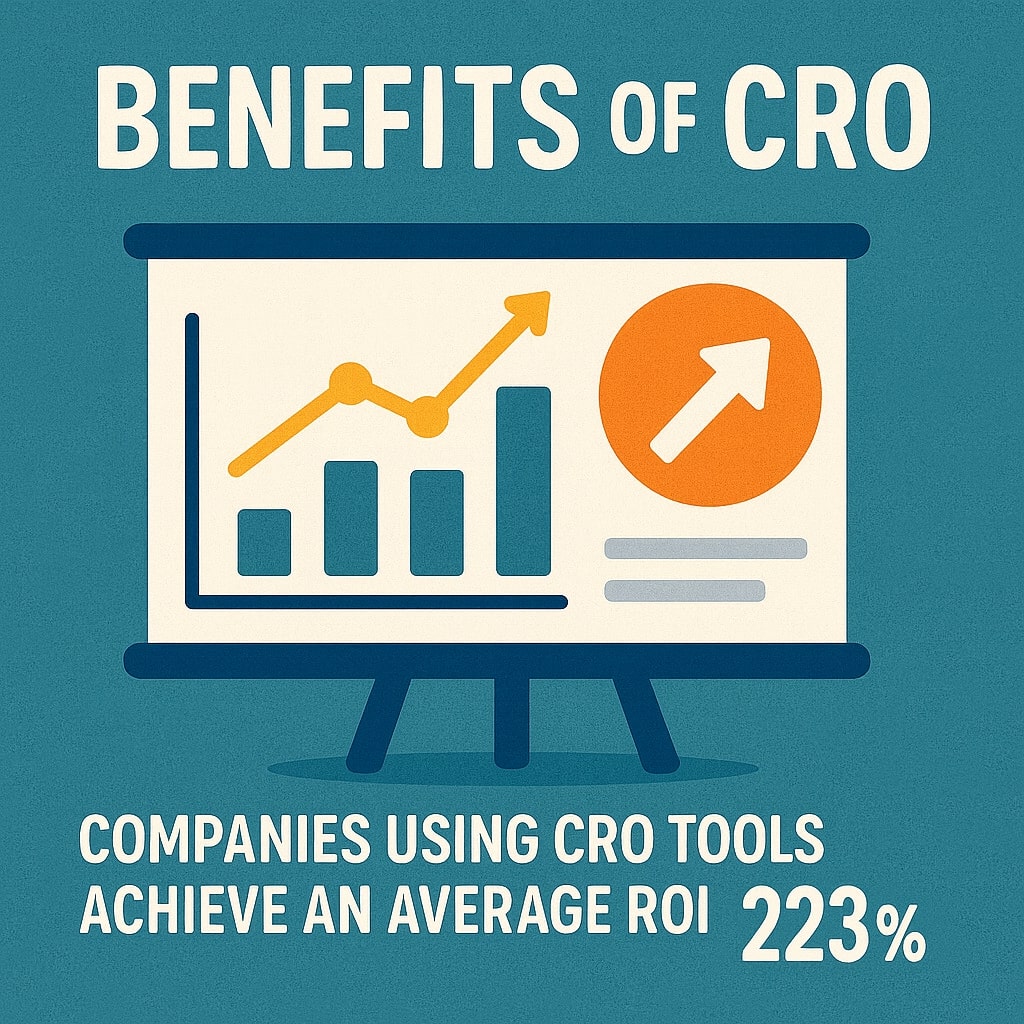
Businesses using CRO tools achieve an average 223% ROI, showing it pays for itself many times over. - Benchmarks reveal room to grow
Average website conversion rates sit around 3.3% overall and 2.5–3% for e-commerce, but top performers hit 6–12%, proving big gains are possible. - Mobile remains the weak link
Despite driving 75% of sessions, mobile conversions trail desktop. Cart abandonment on mobile can exceed 80%, highlighting the urgency of mobile-first optimization. - User experience drives loyalty
Roughly 88% of shoppers don’t return after a poor UX. Reducing friction in navigation, forms, and checkout improves both conversions and retention. - Testing is the engine of CRO
A/B and multivariate tests uncover what works. Most marketers only run one or two tests a month, but consistent testing compounds into major gains. - Frameworks help prioritize
Scoring methods like PIE (Potential, Importance, Ease) or ICE (Impact, Confidence, Effort) ensure limited resources are spent on the most valuable experiments. - Documentation builds momentum
Fewer than 40% of companies document their CRO strategy. Recording goals, hypotheses, and results prevents knowledge loss and accelerates growth. - Personalization converts dramatically better
Personalized CTAs convert 202% more than generic ones, and tailored offers can lift lead generation by over 40%. - AI is reshaping CRO
Adoption is projected to grow from 5% in 2021 to 30% in 2025. AI predicts user intent, automates testing, and personalizes experiences at scale. - Trust and credibility matter
Reviews, testimonials, security badges, and client logos reduce anxiety and build confidence, especially near CTAs and checkout. - Speed is a silent killer
Pages loading in 0–4 seconds convert best. Every extra second increases bounce rates, making performance optimization essential. - Forms and checkout are critical choke points
Shorter forms, guest checkout, auto-fill, and multiple payment options reduce abandonment and drive higher completions. - CRO looks different by industry
- E-commerce: optimize product discovery, trust, and checkout.
- B2B: focus on micro-conversions like demos or whitepaper downloads.
- SaaS: streamline free-trial sign-ups and onboarding flows.
- Content sites: maximize subscriptions and engagement.
- Metrics beyond conversion rate matter
Bounce rate, CTR, session duration, cart abandonment, and form completion rates reveal where friction lives in the funnel. - CRO is continuous and collaborative
It’s not a one-off project. Success comes from ongoing cycles of research, testing, iteration, and scaling—driven by teams spanning marketing, design, analytics, and product.
Conversion rate optimization is both a science and an art. It starts with recognizing the gap between visitor intent and action. Then it applies research, testing and personalization to bridge that gap.
By measuring performance, focusing on high-impact improvements and embracing AI-driven personalization, businesses can turn underperforming pages into engines of growth. Even incremental changes can produce outsized results. Fewer form fields, faster load times, clear CTAs—these small improvements matter.
Continuous experimentation helps ensure success. Support it with a documented strategy and the right tools. Your site will not only attract visitors but convert them into loyal customers.
CRO is also a collaborative practice. Digital marketers, UX designers, business owners, SEO specialists, growth hackers, content strategists, e-commerce managers and data analysts each bring valuable perspectives to the process.
When teams work together, they create user-friendly experiences. They set goals, design experiments, implement changes and analyze results. This drives measurable business outcomes.